HiPP Baby Care
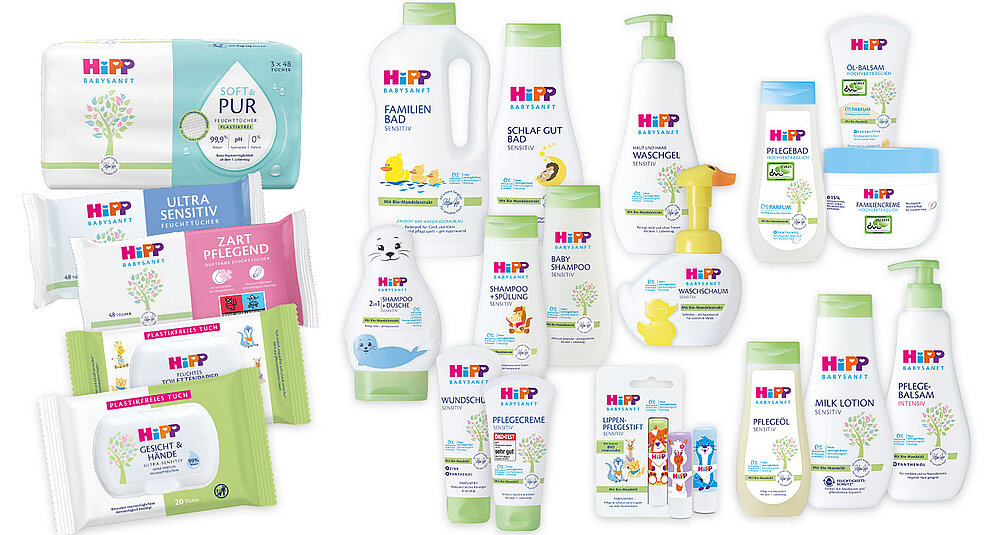
We have gathered some important and good-to-know information for you concerning our HiPP Babysanft product line. You can read more about these topics:

biodegradable formula with no microplastics
Baby skin
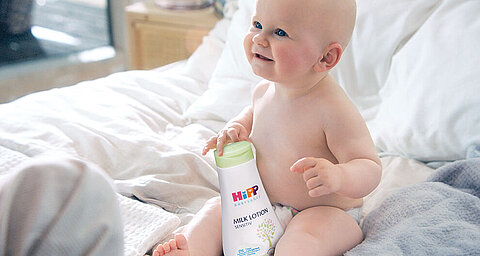
What is special about baby skin?
Baby skin is much thinner than adult skin and the stratum corneum is looser in structure and less resistant. The barrier effect of the stratum corneum against harmful substances is therefore weaker and the skin reacts more sensitively to environmental influences.
The skin's natural acid mantle only develops in newborns after a few weeks and regenerates much more slowly in older children than in adults. It has an important role in warding off bacteria and pathogens.
The stratum corneum of children's skin has a higher moisture content than that of adults. At the same time, however, sebum production in children is still greatly reduced. As a result, babies' and children's skin is covered with only a very thin film of water and oil and can easily dry out. It also offers less protection against the cold and injuries.
Why use baby care products at all?
After birth, a baby's skin has to quickly adapt to a new environment. After many months in amniotic fluid, it now has to adjust to the air and external environmental influences.
For a while, it was thought that care and washing products were not necessary for baby care. However, we now know that washing with water alone dries out baby skin. But because baby skin is very sensitive, it cannot tolerate the same care products as adult skin.
That is why we at HiPP have developed our particularly mild HiPP Babysanft baby care range, which is completely free from undesirable substances and takes into account the special needs of sensitive baby skin.
HiPP organic almond oil
Gentle care with high-quality organic almond oil
Almond oil is one of the highest quality skin care oils with excellent nourishing properties.
As it is particularly well tolerated by sensitive and dry skin, almond oil has proven itself especially effective in caring for sensitive and dry baby and children's skin.
What is almond oil?
Why is organic almond oil so high quality?
Why is organic almond oil so suitable for baby care?
Why is HiPP Babysanft with organic almond oil so popular with midwives?
How is our HiPP Babysanft Organic Almond Oil produced?
What is almond oil?
Almond oil, or sweet almond oil (INCI: Prunus amygdalus dulcis), is a fatty vegetable oil extracted from almonds by cold pressing.
Almond oil is traditionally used in skin care and helps with grazes, eczema and other skin irritations.
Why is organic almond oil so high quality?
The oil content of an almond kernel is between 50 and 55 %. Due to its composition, almond oil is one of the highest quality skin care oils and has very good nourishing properties:
- monounsaturated and polyunsaturated fatty acids, which nourish and protect the skin particularly gently
- high oleic acid content, which makes the skin feel soft
- skin-active linoleic acid, which has a positive effect on dry skin
Almond oil also contains natural vitamin E (tocopherol), which has an antioxidant effect and thus protects the skin from external influences. Almond oil is renewable, biodegradable and therefore environmentally friendly.
Why is organic almond oil so suitable for baby care?
Almond oil has been used in cosmetics for centuries and has been proven since ancient times to be particularly effective in the care of sensitive baby and children's skin, as it is well tolerated by sensitive and dry skin and is recommended for moisturising. Due to its nourishing effect combined with its particular mildness, it is recommended by midwives for baby care. It is also ideal as a massage oil.
Why is HiPP Babysanft with organic almond oil so popular with midwives?
Almond oil has many uses and is ideal for the whole family: for babies, it is used for baby massage and for care after bathing on still damp skin, while mothers can also use it on their face and body. Organic almond oil also has an antioxidant effect, meaning it traps skin-damaging free radicals. The scent of the products is very pleasant: gentle and unobtrusive. In addition, the products are absorbed very quickly and without leaving any residue, which makes it easier to dress the baby and prevents stains on clothing.
How is our HiPP Babysanft Organic Almond Oil produced?
Our organic almond oil is produced from ripe, sweet almonds – known as ‘pinchados’. The almond harvest in Spain and Italy takes place in August, after which the almonds are brought to Germany for further processing. Here, only selected almond kernels of the highest quality are cold-pressed and then filtered. The almonds are pressed mechanically. Filtration removes unwanted protein components from the oil. Only this purification process can guarantee consistent product quality and safety.
Improved formula
The term ‘microplastics’ is cropping up more and more often in discussions about environmental protection. But what does the term actually mean? We have the answer.
Free from microplastics

Microplastics enter the environment through cosmetics, among other things, causing significant pollution and damage. Out of a sense of responsibility for our ecosystems, HiPP has decided to refrain from using solid microplastic particles.
To go one step further, we have now also optimised the formulas of our HiPP Babysanft products so that HiPP can additionally refrain from using liquid polymers.
Therefore, look out for our ‘wave icon’. Products marked with this seal are completely free of microplastics (in any form).
What are microplastics?
HiPP care products in the Babysanft and Mamasanft ranges have never contained microplastics. Microplastics are defined as undissolved solid particles smaller than 5 millimetres. A distinction is made between ‘primary’ and ‘secondary’ microplastics:
- Some manufacturers deliberately use primary microplastics as an ingredient in cosmetic products. They are mostly found in the form of abrasive particles in toothpastes, exfoliants or shower gels.
- Secondary microplastics, on the other hand, are created by breaking down larger pieces of plastic. For example, microplastics enter the sea through plastic bag waste.
The terms ‘primary’ and ‘secondary’ therefore explain the origin of microplastics.
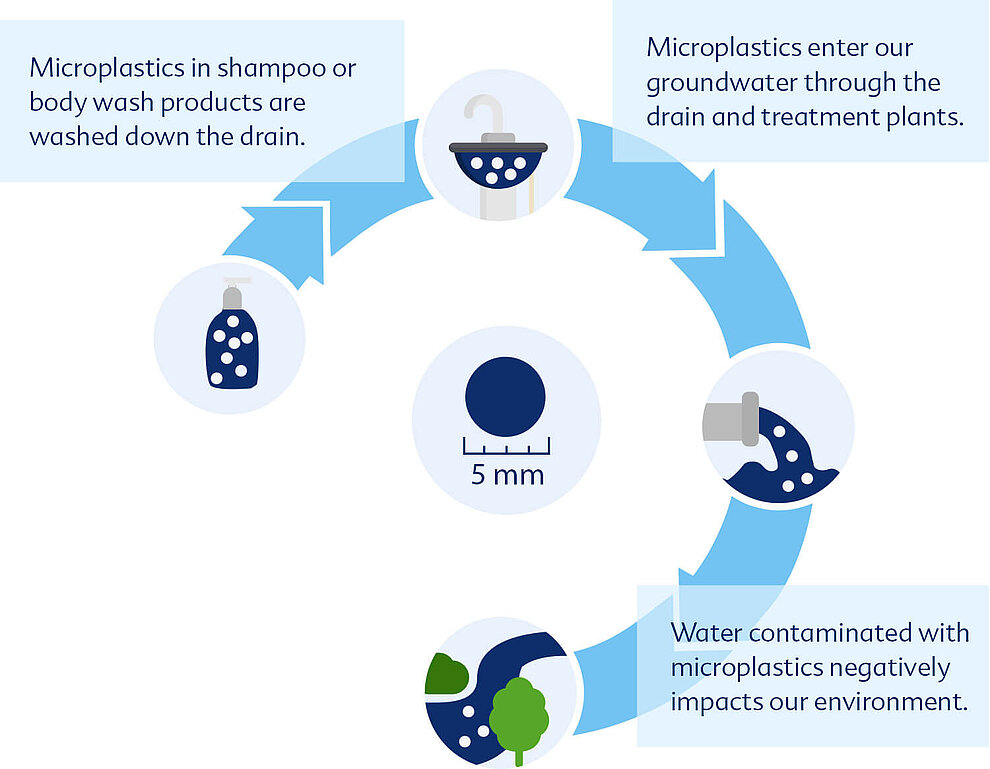
Environmental impact of solid microplastics
What are liquid polymers?
Liquid polymers are synthetically produced plastics. However, unlike microplastics, they do not form particles in cosmetic products, but are present in liquid form. Liquid polymers fulfil various functions in cosmetic products and have been used frequently in the past (not only by HiPP), for example
- as consistency enhancers for the gel-like consistency of shampoo
- as film formers for a pleasant-feeling film on the skin
What is the difference between microplastics and liquid polymers?
Unfortunately, in public debate, the terms ‘microplastics’ and ‘liquid polymers’ are often used interchangeably.
However, microplastics are always solids. Their shape can vary (from round particles to long, thin fibres smaller than 5 mm). Liquid polymers, on the other hand, are never present as solids in cosmetic products, but are always dissolved or emulsified.
How do microplastics and liquid polymers enter the environment?
In addition to solid microplastics, liquid polymers are increasingly the subject of public debate, as they are not biodegradable or are difficult to biodegrade.
Most of the microplastics and liquid polymers that are washed down the drain with the water in shower gel or shampoo end up in sewage treatment plants, where they bind to the sewage sludge. In Germany, most of this sludge is incinerated, but some of it is also used as fertiliser on fields.
Microplastics or liquid polymers used in creams and lotions could also enter the environment in this way after cleansing the skin or washing used textiles.
Liquid polymers at HiPP?
Protecting health and the environment is our top priority. With regard to environmental compatibility, we have no evidence to suggest that dissolved or emulsified polymers cause environmental problems.
Free from everything that sensitive skin doesn't like.

Particularly skin-friendly care for sensitive skin
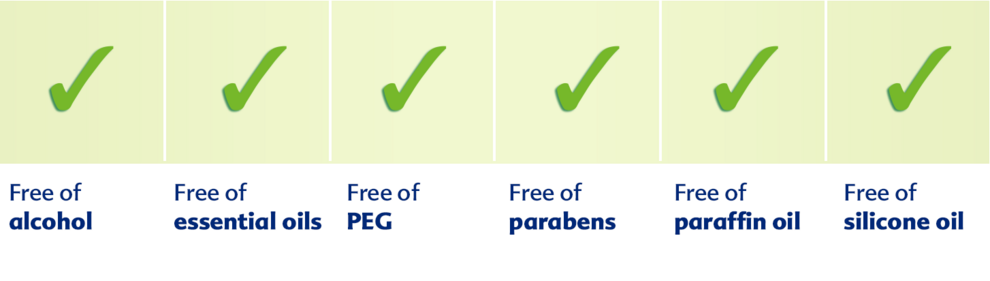
HiPP Babysanft was developed to minimise allergy risks for particularly sensitive skin right from the start. That is why HiPP consistently avoids essential oils and also parabens, paraffin oil and many other ingredients.
Valuable organic almond oil nourishes and protects delicate skin in a completely natural way. Trust HiPP Babysanft because it contains nothing that is not gentle on babies.
HiPP Babysanft consistently avoids: